
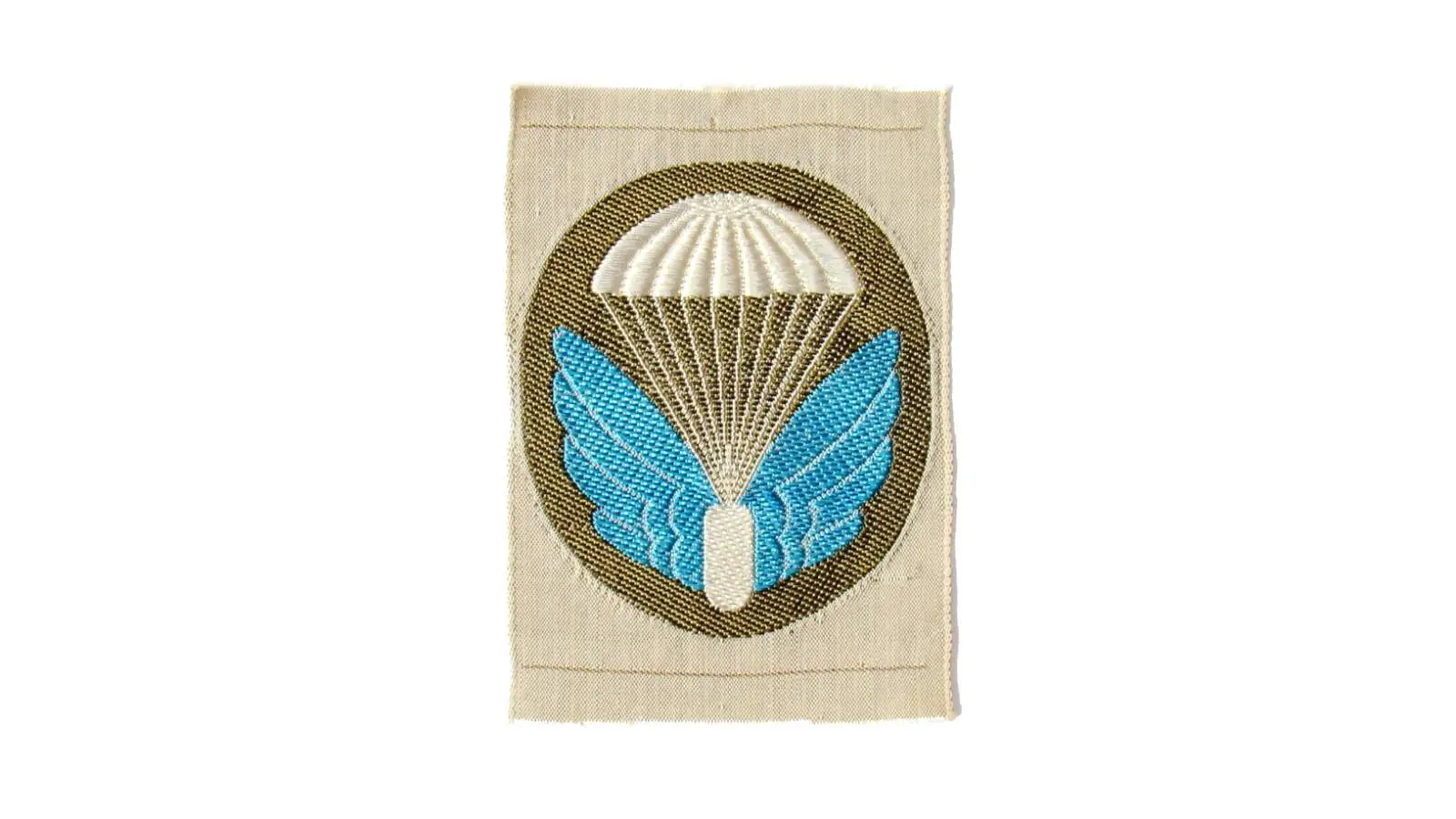
Para patches – overview of series and their use
Sleeve Patches of ČSLA Airborne Units
Overview of sleeve patches worn by the airborne units of the Czechoslovak People's Army from their introduction in 1949 until the dissolution of the ČSLA in 1992.
First woven para patch (1949–1964)
The first oval-shaped sleeve insignia – the so-called “egg” – was introduced by Bulletin of the Ministry of Defence No. 24/49 in 1949 to distinguish Czechoslovak airborne units from other branches of the armed forces. The patch is white, with the oval bearing a brown parachute emblem. It was worn above the left upper arm of the vz. 60 blouse, and occasionally on the vz. 19 blouse.
A rhombus-shaped sleeve insignia was introduced in the 22nd Airborne Brigade in 1964 – from then on the oval insignia was gradually replaced by the rhombus.
Fotogalerie
First series (1960–1980)
The first series of rhombus-shaped para patches, used roughly between 1960 and 1980. The oval containing the parachute emblem is brown. The patch is woven and backed with felt.
Fotogalerie
Second series (1980–1988)
The second series of para patches, used between 1980 and 1988. The oval containing the parachute emblem is white. The patch is woven and backed with felt.
Fotogalerie
Third series (1988–1992)
The third and final series of ČSLA para patches, used between 1988 and 1992. The oval containing the parachute emblem is brown. The patch is made of nylon – unlike the previous series it is neither woven nor backed with felt.
The dates of use for the individual series of para patches are only indicative – there are known cases where this was not the case. For example, during the IFOR peacekeeping operation in 1995–96, members of the 44th Airborne Reconnaissance Battalion from Bechyně wore the nylon patches (the last series).
Fotogalerie
Use of para patches – colour distinction
The rhombus-shaped sleeve insignia was introduced in the 22nd Airborne Brigade in 1964. The colour coding of battalions was introduced primarily to make it easier for paratroopers to orient themselves on the drop zone when several units jumped together.
Original distinction (22nd Airborne Brigade)
After the 22nd Airborne Brigade was disbanded and reorganised into the 22nd Airborne Regiment (1969), the meaning of the colour coding changed. Likewise, the significance of the colour distinction varied among the divisional reconnaissance battalions (airborne companies). However, it was never standardised what the colours were meant to denote – it was rather a matter of tradition, and each company commander interpreted their use in his own way.