
UTON vz.75
Army Tests of UTON vz.75
Secret tests of the first NU-75 series in the VZS 080 laboratories — protocol no. 1286/76.
When the first series of the assault knife vz. 75 (NU-75) was being prepared for service in 1976, it had to undergo brutal tests in the VZS 080 laboratories. The surviving protocol no. 1286/76 reveals fascinating details about how the new knives performed under extreme conditions and where their weaknesses lay.
Photo Gallery
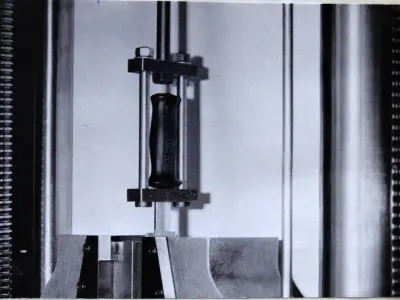
Army tests UTON vz.75 – handle pull-off test
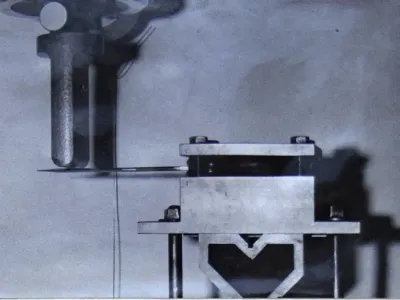
Army tests UTON vz.75 – clamped in fixture
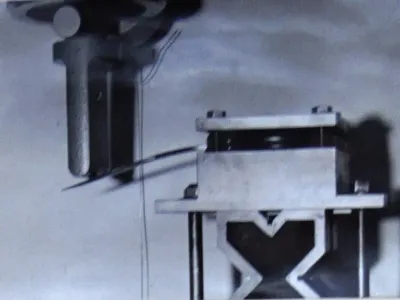
Army tests UTON vz.75 – blade bend test at 400 N
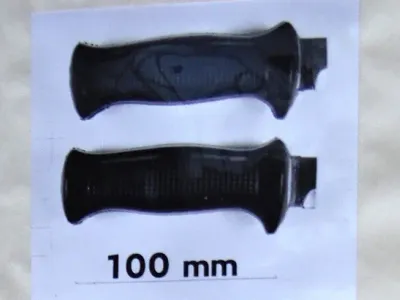
Army tests UTON vz.75 – broken blades
1. Tensile and Bend Tests: 200 kg on the Handle
One of the key tests was the static strength of the blade-to-handle joint. On the ZWICK electronic tensile testing machine, the rubber handle was pulled off the blade tang with measured force.
Result: Even at a load of 2,000 N (approx. 200 kg), the blade did not come loose. The technical specification requirement was met with flying colors.
2. Bend Tests in Frost: Where Was the Weak Point?
Bend tests were carried out both at room temperature (+23 °C) and in extreme frost (−22 °C using dry ice).
Critical finding: The blades did not break immediately, but fracture always occurred at the same location — at the stamped series number.
Consequence: Stamping the numbers created a so-called notch effect in the steel, which reduced its strength. The protocol therefore recommended moving the numbering to the centre of the blade and stamping it longitudinally to increase resistance.
3. Material Composition: Steel Below the Specification Limit?
The protocol analyses in detail the chemical composition of the steels used:
- Blade: Stainless steel 17029 was used. Laboratory analysis at the time found carbon content just below the lower limit of the specification.
- Saw: Steel 14180 was used.
- Hardness: Blades achieved hardness of 50–58 HRC, which corresponded to the lower half of the then-current specification. Files were harder, up to 60 HRC.
4. Accessory Tests: The Saw as a Screwdriver
The army also tested the flat screwdriver at the end of the saw. It was stressed by torsion using a torque wrench.
- The first saw tested deformed at a torque of 20 Nm and broke at 25 Nm.
- On other samples, the screwdriver slipped out of the slot due to its wedge-shaped grinding.
Conclusion: Although minor defects appeared, the saw as a whole met requirements in terms of flexibility and durability.
5. Final Verdict from 1976
Despite the identified partial shortcomings — such as minor dimensional deviations or the effect of number stamping on strength — the laboratory concluded that the assault knife vz. 75 meets requirements and that the properties of the first NU-75 series are sufficient for military purposes.
It is precisely these tests and the subsequent minor adjustments to the manufacturing technology that are behind the UTON becoming a knife that still serves in the Czech army today and has become a legend among collectors around the world.
- Protocol
- no. 1286/76
- Laboratory
- VZS 080
- Series
- NU-75 (0001)
- Year of tests
- 1976
- Tensile machine
- ZWICK
- Joint strength
- ≥ 2,000 N (200 kg)
- Blade hardness
- 50–58 HRC
- File hardness
- up to 60 HRC
- Test temperature
- +23 °C / −22 °C