Paratrooper · Scout · Sniper
Model Badges
ČSLA honorary badges for model soldiers and NCOs on basic military service, introduced 1 January 1951.
Model badges were introduced on 1 January 1951 as honorary distinctions for model privates (lance corporals) and NCOs on basic military service. They were used until 1962.
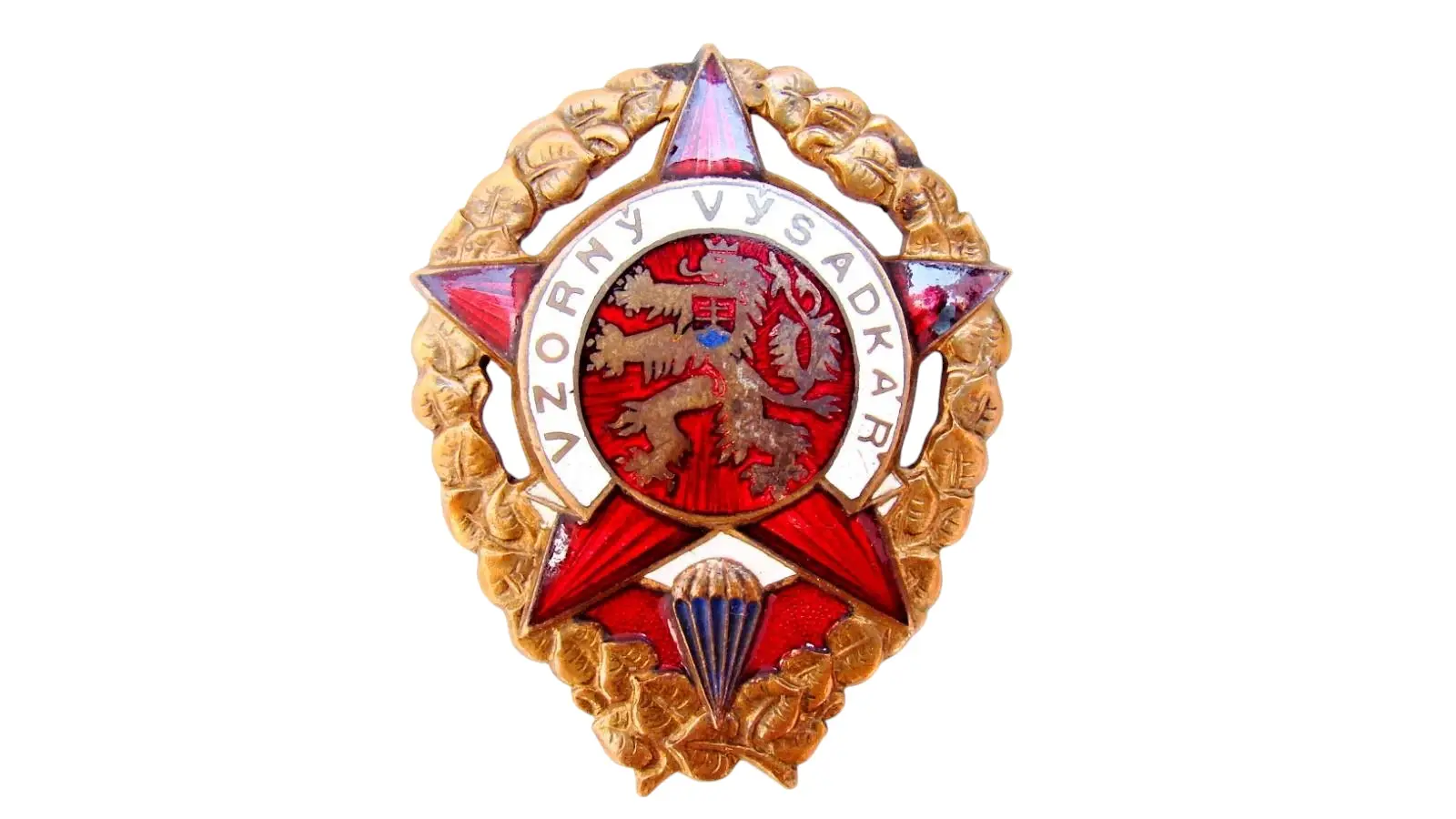
The badge is 46 mm wide and 51 mm tall. The base is a five-pointed red star with a Czech lion bearing the Slovak coat of arms on its chest. The badges were made of yellow tombac and are enamelled. They were attached to the uniform using a screw and nut. A small plate with a serial number is welded to the reverse at the bottom.
Model Paratrooper
The MODEL PARATROOPER badge features a parachute. The badge shown bears serial number 00065 – it belonged to Major Solař (Chief of Armament Service in Prostějov) and was acquired from his son.
The Model Paratrooper badge belongs to category VV – Very Rare.
Model Scout
The MODEL SCOUT badge features a crossed submachine gun and combat knife. The badge shown bears serial number 02470.
Model Sniper
The MODEL SNIPER badge features a rifle with scope. The badge shown bears serial number 00756.
The Model Sniper badge belongs to category V – Rare.
Rarity Grades
U – Unique
Badge occurring only sporadically – rated highest.
VV – Very Rare
Occurs in small quantities; usually the highest performance class or only a small number were ever awarded.
V – Rare
Occurs more frequently but was difficult to obtain during its period of validity, or the period of validity was very short.
Factors determining value when buying or selling
- a)Condition – whether the badge is undamaged, not deformed, enamel not chipped, original patina not worn etc.
- b)Completeness – whether all parts are present and the original nut is preserved.
- c)Award certificate – the number on the certificate must match the number on the badge.
- d)The lower the serial number, the more interesting the badge.
- e)The holder's identity – a badge belonging to a staff officer or ASD (Army Sports Club) member is generally more valuable than one belonging to a regular soldier.
What to look out for when buying
Pay particular attention to the enamel in the star, which tends to fall out with use. Damaged areas are often repaired with nail varnish or similar products. These repairs can be detected by rotating the badge – under different angles of light the surface will appear uneven.
Be aware that replicas of these badges are also produced, which are usually immediately recognisable by their brand-new appearance.