ČSLA and ACR Airborne Forces
Paratrooper Performance Badges
Overview of paratrooper performance badges from 1944 to the present.
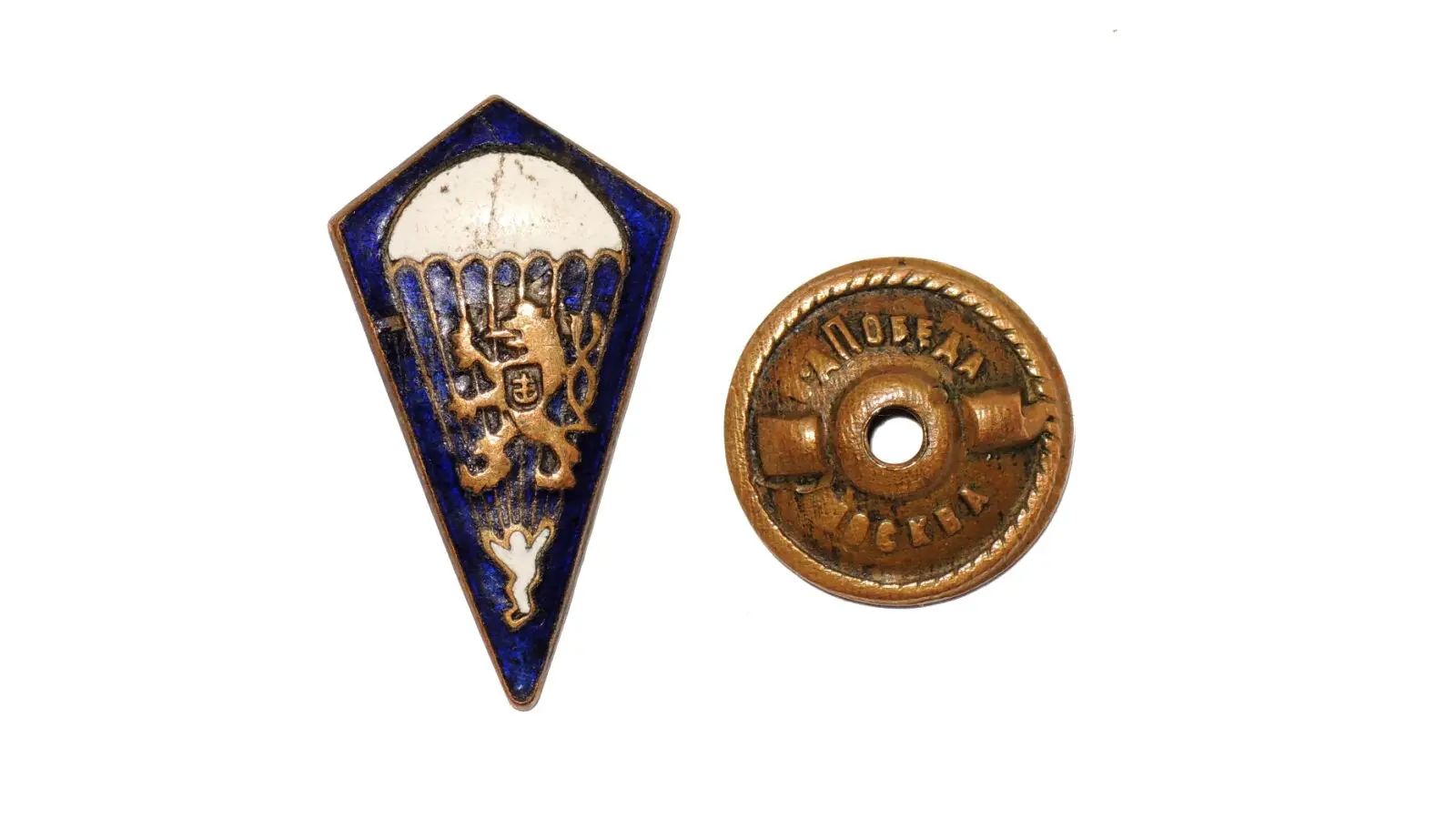
Badge of the 2nd Parachute Brigade
This is an enamelled badge made of yellow tombac. It has the shape of a rhombus with an elongated lower section. The height is 33 mm and the width 18 mm. The badge was manufactured in the USSR in the summer of 1944, with 2,257 pieces produced. On a blue background it shows a white parachute canopy and a white figure of a paratrooper. The entire edge of the badge is in gold, together with the outline of the canopy and figure connected by 8 suspension lines. In the lines of the parachute is the Czechoslovak state coat of arms. On the reverse side the nut bears a Cyrillic inscription indicating the manufacturer: Pobeda, Moscow.
This badge is rarely seen, and most examples are damaged — the enamel falls out very easily. Repaired examples do appear and can be identified by the colour of the enamel. Minor enamel losses in the suspension lines of the canopy are visible on my own badge, as shown in the photographs here.
Fotogalerie
Paraplacky
These badges were introduced in 1948 and used until 1951. Both have an elliptical shape, 44 mm wide and 60 mm tall. The badge consists of a wreath, a parachute and a lion representing the state coat of arms. The base plate has an elliptical shape with a serial number engraved on its underside. The wreath is attached with four hooks, the parachute with two hooks and the lion with three.
Examples also exist that are struck from a single piece (wreath and base plate combined). They were made from tombac, and a silver version occasionally appears — this is an unofficial variant visible in the third row of photographs. These badges are today found fairly often and in varying condition; most have the red enamel in the ribbon missing.
Fotogalerie
Paraplacka – Miniature
These badges were produced by the firm Karnet Kyselý of Prague (hallmark KK), and later after nationalisation also by Zukov. The KK firm hallmarked badges on the reverse (visible in the photograph). Zukov hallmarked the pin instead, which weakened it and caused frequent breakage — hence most surviving examples today have a broken pin tip.
The badges were made of silver and are very rarely seen today. Their current market value is around 40 percent of the price of a large paraplacka — in my view too low, since this badge is rarer and fewer were made than the large version.
Fotogalerie
Tombac Version (1951–1962)
These badges are known as the lime-blossom badge — the so-called lipák — or the hammer-and-sickle badge. They are made of tombac, 25 mm wide and 47 mm tall. Badges of this series usually have serial numbers on the reverse, either stamped directly into the badge or on a small plate. The number is either within a star or within the canopy.
They were introduced and awarded from 1951 to 1962. There are 3 basic types plus one chrome-plated variant that soldiers had made privately. The photographs also show an original certificate authorising the wearer to wear the paratrooper badge. This series is highly sought after by collectors today, as few survive — particularly the Instructor and Master grades.
Fotogalerie
Tombac Version – Angel Wings (1962–1965)
The Angel Wings version was used from 1962 to 1965. The badges are 28 mm wide and 50 mm tall, made of tombac. Badges of this series have serial numbers on a small plate attached to the reverse. This plate is missing from most surviving examples, as it was glued on and fell off over time. They were fastened to the uniform using a screw and nut.
This series is very desirable among collectors today, as it was used for only three years and very few survive — particularly the Instructor and Master grades. Their market value reflects this accordingly.
Fotogalerie
Tombac Version – Heavy Variant (1965–1992)
The tombac series (heavy version) was used from 1965 to 1992. Badges are 26 mm wide and 50 mm tall, usually enamelled and bearing serial numbers. Two types exist within this variant.
The first type has the numerical marking on the canopy and the red enamel in the star sits below the surface of the star. The second type has the marking within the suspension lines of the parachute and the red enamel sits flush with the edges of the star. The two versions also differ in enamel colour — the first variant has a distinctly blue enamel, while the later variant has a greenish hue. Both were fastened to the uniform using a screw and nut.
Fotogalerie
Aluminium Version – Light Variant (1965–1992)
The aluminium series was used from 1965 to 1992. Badges are 26 mm wide and 50 mm tall. This series has no serial numbers and enamel is replaced by paint. Within this series the Instructor grade appears in two versions: gold and red. The gold Instructor was reportedly confused with the Master grade, and was therefore replaced by an Instructor badge with red lettering. Fastened to the uniform using a screw and nut.
The last two photographs show miniatures, which featured only the aircraft. The reverse of the darker version shows the manufacturer's logo and a serial number.
Fotogalerie
Aluminium ACR Version (1993–2011)
The penultimate series, used from 1993 to 2011. Badges are 37 mm wide and 50 mm tall, pressed from an aluminium alloy. Fastened to the uniform using a screw and nut. In the lower part of the badge is a ribbon with the performance grade stamped in the centre. The first badge without a grade is silver and is awarded with a certificate (see photograph). All remaining badges are gold.
Fotogalerie
Award Conditions – ACR Paratrooper Badge
Awarded according to Výs 3-1, Annex 12. The paratrooper badge is a symbol of the difficulty and demanding nature of service in the airborne specialisation. It is awarded to active-duty soldiers upon fulfilment of the conditions listed below.
Silver Badge
Upon completion of 5 parachute jumps, including one at night and one with personal equipment container. Awarded by the unit commander.
Gold Badge – 1st Grade
Upon completion of 50 parachute jumps, including at least 10 at night and 10 with personal equipment container. Awarded by the unit commander.
Gold Badge – 2nd Grade
Upon completion of 100 parachute jumps, including at least 15 at night, 15 with personal equipment container, 10 into unknown terrain, 5 with free-fall exit from at least 1,000 m altitude with landing within 20 m of the designated drop zone centre. Awarded by the military command commander.
Gold Badge – 3rd Grade
Upon completion of 200 parachute jumps, including at least 40 at night, 25 with personal equipment container, 20 into unknown terrain, 10 with water landing, 5 with free-fall exit from at least 1,000 m altitude with landing within 10 m of the designated drop zone centre. Awarded by the head of department according to professional subordination.
The badge is awarded on the 1st day of the month following the month in which the conditions were fulfilled. The nomination is submitted by the superior through the chain of command; fulfilment of conditions is documented by a parachute jump record. The holder is authorised to wear the badge during active service in the ACR in accordance with the uniform regulations.
Latest ACR Version (2011 – present)
The latest series in use from 2011 to the present. Grades are distinguished by the colour of the canopy and the lion:
- 3rd Grade – canopy and lion in bronze
- 2nd Grade – canopy and lion in silver
- 1st Grade – canopy in silver, lion in gold
- Master – canopy and lion in gold
Fotogalerie
Requirements for Individual Grades
Paratrooper Badge – 3rd Grade
Specific prerequisites:
- completion of the basic parachute course
- 10 military parachute jumps, including one at night and one with personal equipment container
Theoretical knowledge:
- content of regulations relating to rescue and parachute training
- parachute and rescue equipment of the unit and rules for its use
- equipment and weaponry of the unit used during insertion
Professional skills:
- packing of main and reserve parachutes used by the unit and their preparation for a jump
Physical training assessment: excellent.
Paratrooper Badge – 2nd Grade
Specific prerequisites:
- holder of the 3rd Grade Paratrooper Badge for at least 2 years
- 50 military parachute jumps, including at least 10 at night, 10 with personal equipment container and 2 with water landing
Theoretical knowledge:
- content of regulations relating to rescue and parachute training
- parachute and rescue equipment of the unit and rules for its use
- equipment and weaponry of the unit used during insertion
Professional skills:
- preparation of unit equipment and weaponry used for the jump and post-jump operations
- packing of main and reserve parachutes used by the unit and their preparation for a jump
- completion of rappel exit on the training facility
Physical training assessment: excellent.
Paratrooper Badge – 1st Grade
Specific prerequisites:
- holder of the 2nd Grade Paratrooper Badge for at least 2 years
- 100 military parachute jumps, including at least 15 at night, 15 with personal equipment container, 10 into unknown terrain and 5 with water landing
Theoretical knowledge:
- content of regulations relating to rescue and parachute training
- parachute and rescue equipment of the unit and rules for its use
- equipment and weaponry of the unit used during insertion
- training methodology on parachute training facility equipment
Professional skills:
- preparation of unit equipment and weaponry used for the jump and post-jump operations
- packing of main and reserve parachutes and their preparation for a jump
- completion of rappel exit from parachute aircraft
Physical training assessment: excellent.
Paratrooper Badge – Master
Specific prerequisites:
- holder of the 1st Grade Paratrooper Badge for at least 3 years
- 200 military parachute jumps, including at least 40 at night, 30 with personal equipment container, 20 into unknown terrain and 10 with water landing
Theoretical knowledge:
- content of regulations relating to rescue and parachute training
- parachute and rescue equipment and rules for its use
- equipment and weaponry of the unit used during insertion
- training methodology on parachute training facility equipment
Professional skills:
- preparation of unit equipment and weaponry used for the jump and post-jump operations
- packing of all types of main and reserve parachutes used in the ACR and their preparation for a jump
- completion of rappel exit on the training facility
Physical training assessment: excellent.