
Automatic Parachute Opening – ČSLA
Semi-automatic Device KAP-3 and KAP-3P
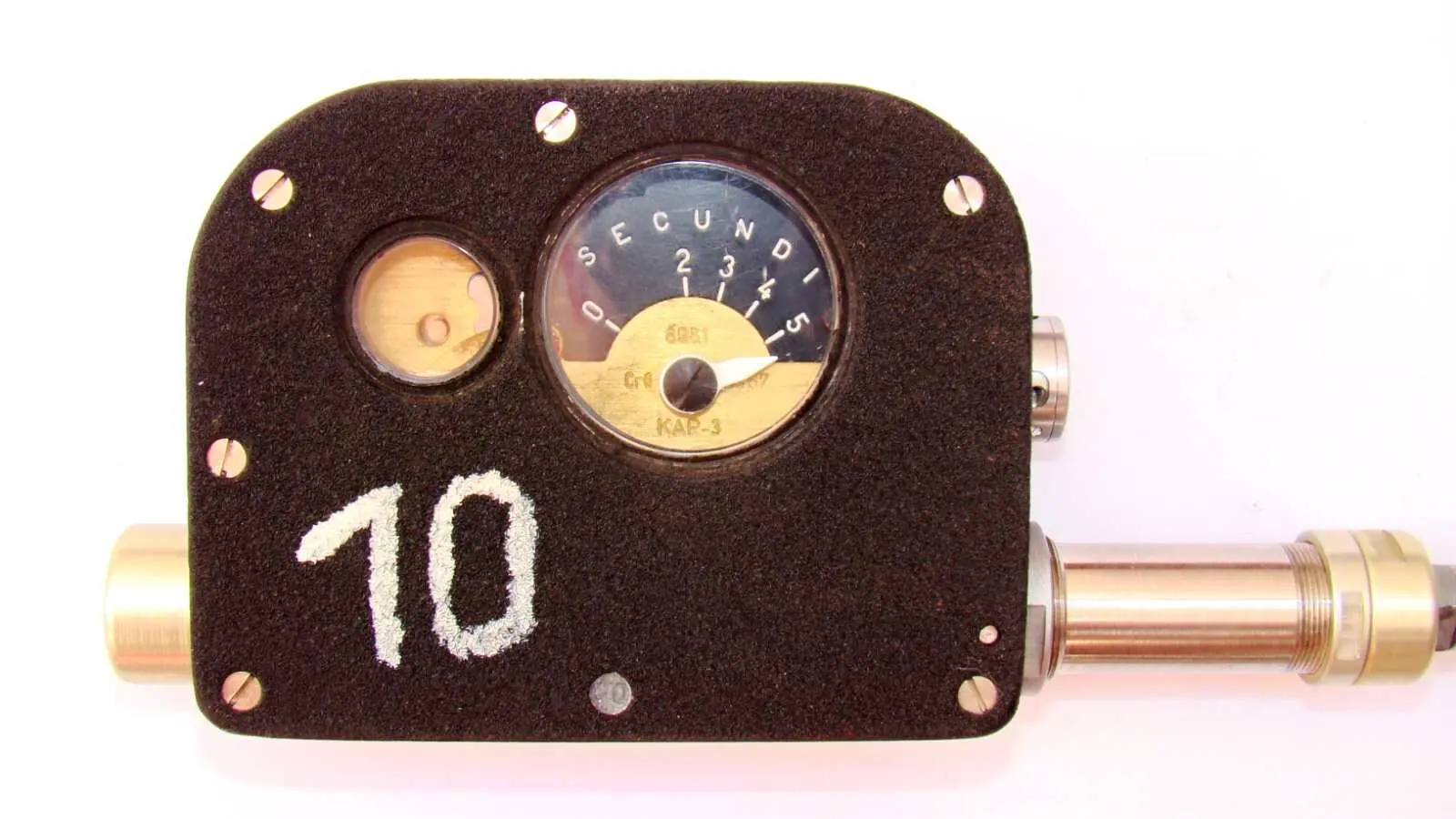
Semi-automatic device KAP-3 – combination of clockwork and aneroid mechanism for automatic parachute opening.
The semi-automatic device KAP-3 is used for automatic parachute opening. It can also serve as a safety backup during training jumps in case the paratrooper is unable to open the parachute manually using the ripcord handle.
The device is a combination of a clockwork and an aneroid mechanism. The clockwork allows the device to be set to activate 2–5 seconds after arming. The aneroid blocks the clockwork on the last second and prevents it from running until the paratrooper has descended to the altitude set on the scale. Once that altitude is reached, the aneroid compresses under rising barometric pressure and releases the clockwork, which processes the remaining 0.8–1.2 seconds and releases the springs connected to the parachute release cable.
The device is activated by pulling the flexible spring safety pin, which is connected to the static line attached to the aircraft. The device does not prevent the paratrooper from opening the parachute manually. The entire mechanism is housed in a cast dural casing.
Technical Specifications KAP-3
Mechanism Functions
Clockwork mechanism
Allows setting the device to a delay of 2–5 seconds from arming. On low-altitude jumps it operates independently and opens the parachute after the set time. The time scale is visible on a dial with a hand through a round aperture in the cover.
Aneroid mechanism
Blocks the clockwork on the last second until the paratrooper descends to the set altitude. Scale divided every 250 m (500–1,000 m) and every 500 m (1,000–4,000 m), visible in a side window. Once the altitude is reached, the aneroid compresses under barometric pressure and releases the clockwork.
Extraction mechanism
After clockwork release, the working springs connected to the parachute release cable are freed. Cable travel is 70 mm ± 2.5 mm. Can be disassembled and reassembled without removing the cover.
Setting the Device
a) Insert the flexible safety pin
The pin must slide in completely freely. If not, rotate the device in the plane of the time scale to allow the flyweight to reach its correct position.
b) Tension the extraction springs
Slide the tensioning stirrup over the loop at the end of the cable, hold it with a foot and pull the device body slowly to the stop.
c) Set the time scale
Pull and re-insert the safety pin to let the clockwork run until the hand reaches the required second on the scale.
d) Secure the safety pin
Thread a single twisted strand of cord through the holes in the rim and the pin loop, then tie 2–3 knots to prevent accidental extraction.
e) Set the altitude scale
Use the square key inserted into the appropriate hole to set the required altitude. Read the altitude of the drop zone from a map and check the barometric pressure – the device is calibrated to standard atmosphere.
Aneroid check before mounting
Before attaching the device to the parachute, look through the small window in the cover and check whether the central aneroid spindle protrudes above the plate surface. If it does, the aneroid is not airtight – the device will not function and must be returned for repair.