ČSLA Paratrooper Equipment
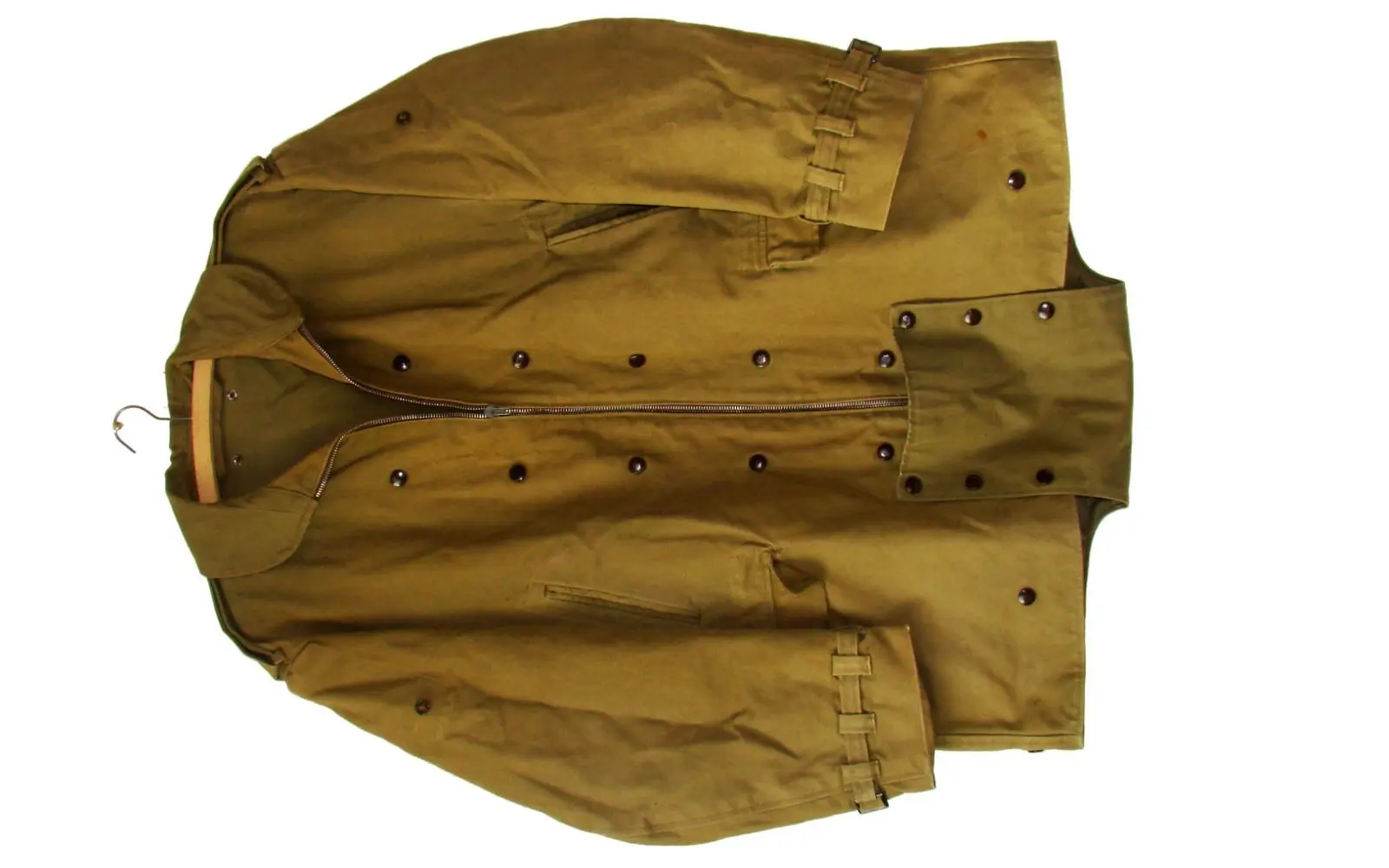
KK Jacket – Short Khaki Jacket
The KK jacket was introduced in the early 1950s for the newly formed Czechoslovak airborne forces, based on the British Denison Smock.
The jackets for paratroopers from the early 1950s were based on the model used by British paratroopers — the Denison Smock. This jacket drew on the experience of German paratroopers from World War II and was worn as the outer layer over the airborne field uniform.
The KK jacket was introduced in the early 1950s into the equipment of the newly formed Czechoslovak airborne forces (71st Infantry Battalion of Czechoslovak Paratroopers) as the first model in khaki colour. Its adoption was pushed through by paratroopers who had undergone para training in Great Britain and served as the first instructors for new recruits.
Its distinctive feature was a permanently sewn flap at the lower back, which was pulled through the crotch during a parachute jump and fastened at the front of the jacket with press studs — preventing the jacket from riding up under the parachute harness or during the jump itself. When not jumping, it was fastened on the inside of the jacket with press studs.
This design feature was carried over into the first domestically produced camouflage jacket, which had button fastening and was worn over the airborne uniform model 19. Over time the camouflage jacket was improved — buttons were replaced by a zip. The standard camouflage pattern was green-brown and beige blotches similar to canvas, but an autumn-spring variant in light brown with irregular brown (oak-leaf) blotches was also used.
These jackets remained in service until the mid-1960s; they were still used alongside the model 19 uniform around 1968. Operational experience with them was entirely positive and they were very popular among paratroopers — setting them apart from other branches of the Czechoslovak People's Army.
Light winter variant with liner
The warm winter liner for the camouflage jacket was made from rabbit fur and attached inside the jacket with press studs. This jacket bears a military acceptance stamp and the year 1954.