
Other Knives
Diving Knife from the PL 40 Kit
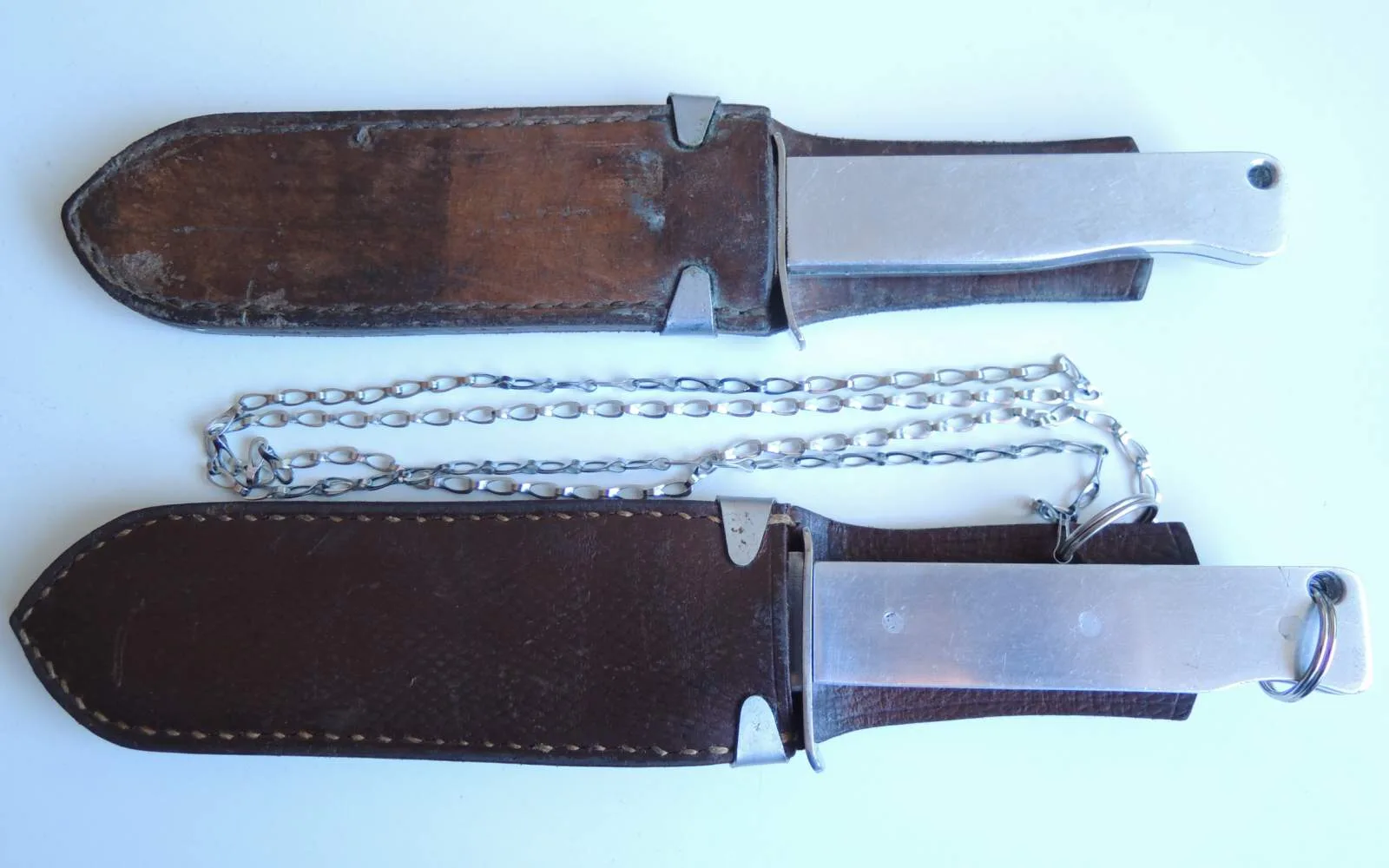
Diving knife from the PL 40 kit, stored in the lid of a transport crate. Probably manufactured in the 1950s–60s.
Fotogalerie
Diving Knife from the PL 40 Kit
These diving knives were stored in PL 40 kits in the lid of the transport crate. The knife has no markings and was probably manufactured in the 1950s–60s. It is depicted in military regulation Žen-24-6 from 1969. The knife was suspended by the sheath hanger on the belt of the diver's chest magazine carrier and served primarily for freeing oneself when entangled in seaweed, ropes and nets.
The knife blade is a straight double-edged blade with a central point, chrome-plated and polished. On the upper side of the blade are 21 one-sided ground saw teeth. The handle consists of two aluminium scales connected through the blade tang by three countersunk aluminium rivets. The underside of the handle is shaped for the hand. In the upper part of the handle is a hole for a ring with an articulated aluminium chain (~100 cm) ending in a carabiner.
There is also a second variant of the knife with a larger finger recess on the handle and double-sided ground teeth on the blade spine. The leather sheath has a steel sheet plate riveted near the mouth with bent arms as a substitute for a throat ferrule. Unfortunately leather sheaths hardened on contact with water and became saturated with oil — most surviving sheaths are in the condition visible in the photographs.
The knife was labelled in Střelecký magazín no. 6/2002 (p. 36) as a diving version of the VO7; it is also mentioned by Mr. Blahout in the book Paratroopers and scouts of the Czechoslovak army (p. 75). According to the author, however, it has nothing in common with the VO7 knife — it is merely a colloquial designation, like "the aluminium one".
Warning: due to the small number of surviving pieces and their collector's value, copies may be encountered. We recommend comparison with an original before purchase.
Technical and tactical data
- Knife length
- 265 mm
- Blade length
- 155 mm
- Blade width
- 31 mm
- Blade thickness
- 1.4 mm